
How Mesh Networking Supports Real-Time Safety Across School Districts

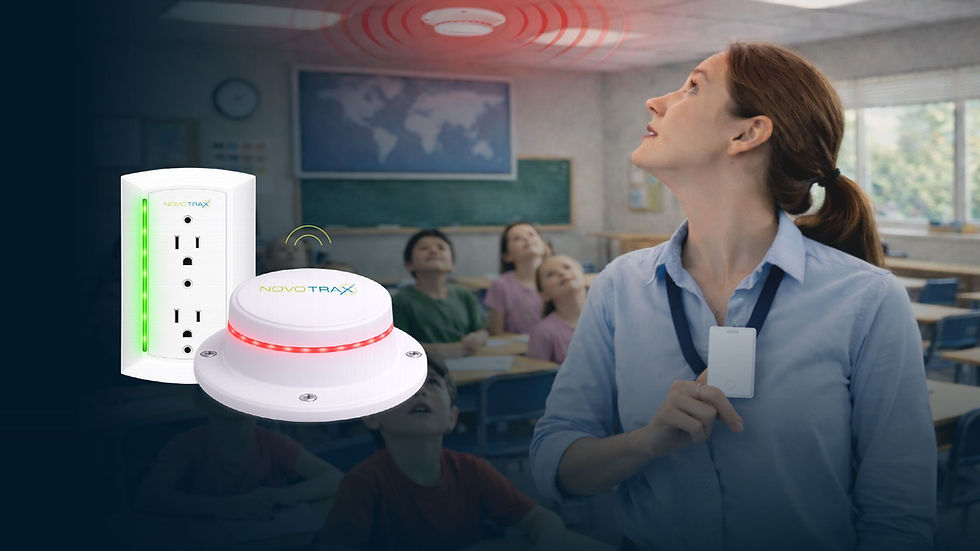
School safety technology is becoming more connected. Districts are deploying panic buttons, RTLS tags, sensors, cameras, access control, mass notification systems, and other technologies across their schools. But as these systems expand, another question becomes increasingly important:
How do you keep all of those devices connected across an entire school district?
A single school building presents one set of connectivity challenges. A district with multiple campuses, athletic facilities, administrative buildings, outdoor areas, and other properties presents another.
Traditional point-to-point approaches can become difficult to scale as the number of connected devices and locations increases. Mesh networking provides a different approach.
Instead of treating every device as an isolated endpoint, a mesh network creates a connected infrastructure in which devices and nodes can communicate through the network and extend connectivity throughout the environment.
For NovoTrax, that infrastructure is powered by the Korvex Gateway and proprietary Mesh Network—creating the connectivity layer that allows safety signals, location data, and connected devices to communicate with the NovoTrax platform.
Why District-Wide Safety Requires a Network Strategy
School districts are rarely made up of identical environments. One campus may consist of a single main building. Another may include several buildings connected by outdoor walkways. A district may also have athletic fields, transportation facilities, administrative offices, and other locations spread across a larger geographic area.
That means a district-wide safety system cannot be designed around one building.
It needs an infrastructure strategy that can scale.
NovoTrax is designed to support environments ranging from individual facilities to multi-campus deployments, connecting alerts, RTLS, communications, video analytics, and security technologies into coordinated workflows.
Mesh networking is an important part of that foundation.
What Is Mesh Networking?
In a traditional network architecture, devices may communicate directly with a central access point or gateway. A mesh network takes a different approach.
Multiple connected nodes work together to extend the network across the environment. Instead of relying exclusively on a single connection point, the network can use connected nodes to help move information through the environment.
For a school district, this can provide a more scalable way to build connectivity across areas that may otherwise be difficult to connect with traditional infrastructure.
The NovoTrax Korvex Gateway is designed to operate as the infrastructure layer behind the NovoTrax proprietary Mesh Network. Korvex can support hundreds of mesh-connected NovoTrax Nodes, helping extend connectivity across buildings and campuses.
The objective is simple:
Create one connected safety environment instead of a collection of isolated devices.
Connecting More Than One School
Consider a district with several schools.
Each location may have:
Staff panic buttons
RTLS tags
Sensors
Connected devices
Emergency communication systems
Security technologies
Location-aware workflows
Without a common connectivity architecture, information can become fragmented by building. A district security team may know what is happening at one location but lack the same level of visibility at another.
A mesh-based architecture helps change that model.
Korvex can provide the underlying connectivity between NovoTrax devices and the cloud, allowing the district to build a connected network across multiple environments.
This creates a foundation for district-wide visibility while still allowing individual campuses to have their own devices, workflows, and operational requirements.
Scaling Connectivity Without Treating Every Device Separately
One of the challenges of district-wide technology is scale. Adding one device is relatively simple.
Adding hundreds or thousands of devices across multiple schools is a different problem.
The network has to accommodate changing requirements, different building layouts, varying distances, and new devices over time.
Korvex is designed to scale across facilities, supporting hundreds of mesh-connected NovoTrax Nodes.
This means districts can think about connectivity as an expandable infrastructure layer rather than rebuilding the network every time a new device or building is added.
That distinction becomes particularly important for districts implementing technology in phases.
A district might begin with one school, expand to several campuses, and eventually deploy district-wide. The network architecture should be capable of growing with that strategy.
Different Environments Need Different Connectivity
A school district is not one uniform environment. Inside a classroom, a connected device may only need to communicate across a relatively short distance. Across an outdoor area, the requirements can be very different.
Korvex supports both Standard BLE and Coded PHY, allowing the system to support indoor connectivity as well as extended-range environments. The technical specifications list typical indoor BLE ranges of approximately 10–30 meters and Coded PHY coverage of approximately 240–400 meters depending on environmental conditions.
This flexibility matters when district deployments extend beyond classrooms.
A connected safety architecture may need to support:
Classrooms → Hallways → Buildings → Outdoor Areas → Campus Infrastructure
The network needs to adapt to those environments rather than assuming they are all the same.
Mesh Networking and Real-Time Location
Mesh networking becomes even more valuable when combined with Real-Time Location Services. NovoTrax RTLS uses BLE sensors, wearable tags, and gateways to provide real-time visibility into the location of people and assets. It can support zone-level, room-level, and, with supported configurations, approximately one-meter location accuracy.
The network provides the infrastructure.
RTLS provides the location intelligence. The NovoTrax platform can then use that information within workflows. For example, a district may want to know where a staff member is when an emergency signal is generated.
The value isn't simply knowing that a device communicated with the network.
The value is connecting that signal with location and context.
That transforms network connectivity into operational intelligence.
Real-Time Does Not Always Mean Constant Transmission
Another consideration for district deployments is how connected devices report information. Different applications require different reporting models.
Korvex supports both continuous streaming and Report-By-Exception (RBE) reporting. Continuous streaming can provide ongoing location information, while RBE transmits information when a defined event occurs—for example, when a panic button is activated.
A location-sensitive application may require continuous visibility. Another application may only need communication when something changes.
RBE can reduce network traffic and extend battery life because connected devices do not need to continuously transmit information when there is no relevant event. The result is a network architecture that can support different operational requirements rather than forcing every device into the same reporting model.
Extending the Network With Korvex Nodes
A district deployment does not necessarily need every connected device to communicate directly with a primary gateway.
The Korvex product family includes the Korvex Node, a wall-mounted relay designed to extend the gateway network.
This creates another layer of flexibility for complex environments. A district may have a building where additional network reach is needed because of the physical layout, construction materials, distance, or the location of connected devices.
Instead of treating that area as a disconnected environment, nodes can help extend the mesh architecture. The result is a network designed around the physical environment of the school—not the other way around.
A Foundation for District-Wide Workflows
The ultimate purpose of connectivity is not connectivity itself. It is what the district can do with the information moving through the network.
NovoTrax's platform connects safety technologies and systems into coordinated workflows. For education, that can include panic alerts, location information, video, communications, access control, and automated response.
Imagine a staff member activates a panic button.
The network carries the event. The platform receives the signal.
Location information provides context. The appropriate personnel are notified.
Connected systems can participate in the predefined workflow.
The district gains visibility into the incident.
What started as a single device event becomes a coordinated response.
The mesh network provides the connectivity. The platform provides the intelligence and orchestration.
Connectivity That Can Grow With the District
School districts change constantly. New buildings are added. Campuses expand. Technology deployments evolve. Security requirements change.
A district's safety infrastructure therefore needs to support more than today's requirements. It needs to provide a foundation for tomorrow's connected campus.
A scalable mesh architecture allows districts to approach deployment incrementally:
Start with one environment.Connect additional buildings.Extend coverage.Add devices.Expand RTLS.Connect more systems.Coordinate more workflows.
This approach allows connectivity to grow alongside the district.
From Connected Devices to Connected Districts
The future of school safety is not defined by how many devices a district deploys.
It is defined by how effectively those devices work together.
Panic buttons should not exist in isolation.
RTLS should not exist in isolation.
Sensors should not exist in isolation.
Communication systems should not exist in isolation.
And individual schools should not have to operate as disconnected safety environments.
A mesh network creates the infrastructure needed to connect those technologies across a larger environment.
With Korvex, NovoTrax extends that concept across buildings and campuses, supporting mesh-connected devices, RTLS, flexible reporting, and multiple connectivity options.
The result is a foundation where information can move from the physical environment into the NovoTrax platform—and from information to coordinated action.
The Network Behind Real-Time Safety
For school districts, real-time safety starts long before an alert reaches a dashboard.
It starts with the infrastructure carrying that information.
A connected district requires a network capable of supporting different buildings, different environments, different devices, and different operational requirements.
Mesh networking provides that foundation.
Korvex helps NovoTrax create a scalable connectivity layer across school environments, connecting devices and extending visibility while supporting the real-time location and workflow capabilities that modern school safety requires.
Because a truly connected school district is not simply a district with more technology.
It is a district where the technology can communicate, share information, and work together.


Comments