
How Korvex Extends Coverage Across Large Campuses: Building the Foundation for Connected Safety and Real-Time Visibility

The Coverage Challenge Facing Modern Organizations
Whether it's a school district, university campus, healthcare system, manufacturing facility, or corporate headquarters, large environments share a common challenge:
How do you maintain reliable visibility and communication across an entire campus?
Many organizations begin their safety and operational technology journey by deploying individual solutions. They install panic buttons, add location tracking tags, deploy sensors, or implement emergency notification systems.
Initially, these solutions work well within a limited area.
But as organizations grow, new challenges emerge:
Multiple buildings spread across a campus
Outdoor spaces between facilities
Parking lots and athletic fields
Remote wings and annexes
Temporary structures
Areas with inconsistent connectivity
Suddenly, the question becomes much bigger than the devices themselves.
The real challenge becomes infrastructure.
Because no matter how advanced a panic button, RTLS tag, or sensor may be, it can only provide value when it can reliably communicate with the systems responsible for monitoring, coordinating, and responding.
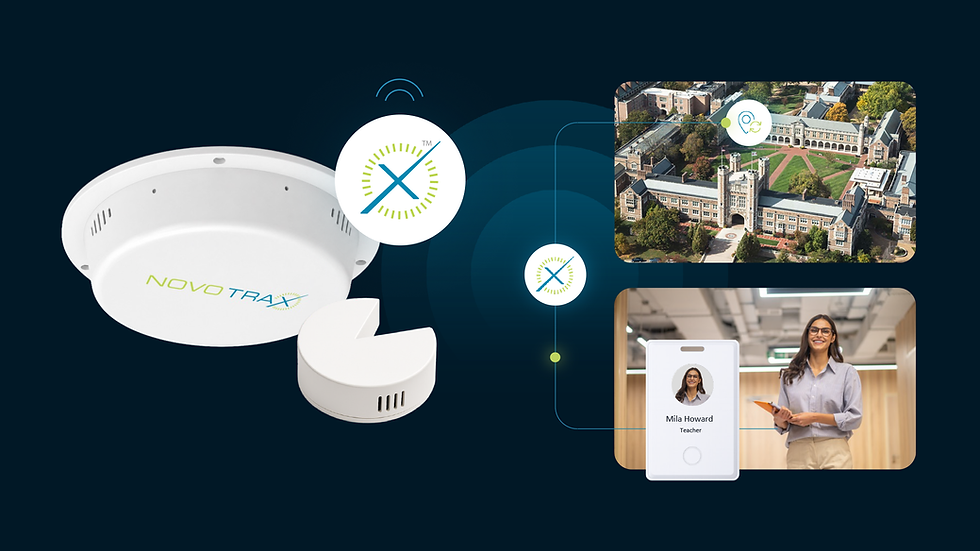
This is where the NovoTrax Korvex Gateway was designed to make a difference.
Why Coverage Matters More Than Most Organizations Realize
When organizations evaluate safety technologies, they often focus on features.
They ask questions like:
How accurate is the location tracking?
What notifications can be sent?
What workflows are supported?
How quickly can alerts be delivered?
These are important questions.
However, there is a more fundamental requirement that often receives less attention:
Can the infrastructure maintain reliable connectivity everywhere it matters?
If the answer is no, every downstream capability is compromised.
Location tracking becomes inconsistent.
Alerts become unreliable.
Visibility becomes fragmented.
Response times increase.
The result is a safety ecosystem with blind spots.
And in emergency situations, blind spots can become critical vulnerabilities.
The Reality of Modern Campuses
Large campuses are rarely confined to a single building.
Consider a typical K-12 school district.
The district may include:
Elementary schools
Middle schools
High schools
Administrative offices
Athletic facilities
Parking areas
Transportation centers
A healthcare system may include:
Multiple patient towers
Emergency departments
Outpatient clinics
Parking garages
Loading docks
Behavioral health facilities
Medical office buildings
A manufacturing campus may span hundreds of acres with:
Production facilities
Warehouses
Distribution centers
Vehicle yards
Administrative offices
Each environment presents unique coverage challenges.
Walls, steel structures, distance, outdoor spaces, and changing layouts all impact connectivity.
Traditional approaches often require organizations to deploy multiple disconnected systems to address these challenges.
Korvex was designed differently.
Beyond a Single Gateway
Many people hear the word "gateway" and imagine a single device responsible for transmitting data. In reality, modern campus environments require something much more sophisticated. Korvex is not simply a gateway.
It is a scalable communication architecture designed to support connected safety and real-time visibility across complex environments.
Instead of relying on a single communication point, Korvex can be deployed as part of a distributed mesh network that expands coverage throughout a facility or campus.
This architecture helps create a connected environment where devices, people, and assets remain visible even as operations expand.
Understanding the Korvex Mesh Network
At the heart of the Korvex architecture is a mesh networking approach.
Traditional networks often depend heavily on centralized communication paths.
If connectivity is disrupted, coverage gaps can emerge.
A mesh network takes a different approach.
Rather than relying solely on one communication path, devices work together to extend network reach across the environment.
This creates several advantages:
Expanded Coverage
Coverage can be extended throughout:
Multiple buildings
Outdoor spaces
Large campuses
Remote areas
Parking facilities
Instead of viewing coverage as a single zone, organizations can build a network that scales with their environment.
Improved Reliability
Large campuses are dynamic.
Construction projects occur.
Buildings are renovated.
Infrastructure changes.
A distributed architecture provides greater flexibility when adapting to these evolving conditions.
Rather than creating isolated technology islands, organizations can maintain a more connected ecosystem.
Simplified Expansion
One of the most significant challenges organizations face is growth.
A school district adds a new building.
A hospital acquires a new clinic.
A manufacturer expands warehouse space.
Traditional systems often require extensive redesigns when coverage areas increase.
Korvex helps simplify expansion by allowing organizations to extend network reach as operational needs evolve.
How Korvex Supports Real-Time Location Services
Coverage is especially important for Real-Time Location Services (RTLS).
RTLS depends on consistent communication between:
Location tags
Sensors
Gateways
Software platforms
If coverage is inconsistent, location visibility becomes inconsistent.
Organizations may experience:
Missing location updates
Delayed reporting
Reduced situational awareness
Incomplete movement history
The Korvex infrastructure helps provide the connectivity required to support real-time location visibility across large environments.
This enables organizations to monitor:
Staff locations
Critical assets
Mobile equipment
Visitors
Emergency resources
The result is a more complete operational picture.
Supporting Both Indoor and Outdoor Environments
One of the biggest challenges for campus-wide deployments is maintaining continuity between indoor and outdoor spaces.
Many systems perform well inside buildings but struggle outdoors.
Others provide broad outdoor coverage but lack indoor precision.
Organizations need both.
A teacher moving from a classroom to an athletic field.
A nurse transporting equipment between facilities.
A maintenance worker crossing a large campus.
A security officer responding to an outdoor incident.
These activities occur across different environments throughout the day.
Korvex helps create a communication layer capable of supporting visibility across both indoor and outdoor operational areas.
This is particularly valuable for organizations where safety events and operational activities are not confined to a single building.
Extending Coverage Without Sacrificing Accuracy
Coverage and precision are often viewed as competing priorities.
Many organizations assume they must choose between:
Broad coverage
Accurate location visibility
Modern deployments require both.
Korvex supports multiple communication approaches, including standard Bluetooth Low Energy (BLE), long-range Coded PHY capabilities, and optional Angle of Arrival (AoA) positioning technologies.
This flexibility allows organizations to design deployments based on their specific operational needs.
Some areas may prioritize broad coverage. Others may require room-level or near-meter-level visibility. The infrastructure can support both objectives within a unified ecosystem.
Campus-Wide Safety Starts With Connectivity
Emergency response is fundamentally a communication challenge.
The first step in any response workflow is ensuring that information can move quickly from the point of detection to the people responsible for taking action.
Consider several common scenarios:
Scenario 1: School Emergency
A staff member activates a wearable panic button from a remote classroom.
The signal must travel through the infrastructure and reach responders immediately.
Coverage gaps create delays.
Reliable connectivity enables faster response.
Scenario 2: Hospital Workplace Violence Event
A nurse requests assistance in a patient care area.
The system needs to identify:
Who initiated the alert
Where it originated
Which responders are closest
This requires continuous communication between devices and the platform.
Scenario 3: Asset Movement Alert
Critical equipment leaves a designated zone.
The organization needs immediate visibility into:
Asset identity
Current location
Movement path
Response workflow
Without infrastructure, these insights may never reach the people who need them.
The Foundation for Connected Response
The true value of Korvex is not simply extending coverage.
Coverage is the starting point.
The larger goal is enabling connected response.
Once reliable connectivity exists, organizations can support:
Real-Time Location Services
Panic button solutions
Asset tracking
Staff safety initiatives
Geofencing workflows
Emergency notifications
Dispatch coordination
Operational visibility
Each of these capabilities depends on one foundational requirement:
Reliable communication between devices, infrastructure, and the NovoTrax platform.
Korvex serves as the layer that helps make that connectivity possible.
From Buildings to Ecosystems
Historically, organizations approached safety one building at a time.
A school secured a school.
A hospital secured a hospital.
A facility secured a facility.
Today's environments are far more interconnected. Organizations now operate across campuses, districts, healthcare networks, and distributed facilities.
As these environments become more complex, safety infrastructure must evolve as well.
The future is not about protecting individual buildings.
It is about creating connected ecosystems where information moves seamlessly, location data remains visible, and response workflows can operate without interruption.
Coverage Is More Than Connectivity
When most people think about coverage, they think about signal strength.
But modern organizations require something much more valuable.
They need operational coverage.
Coverage that ensures:
People remain visible
Assets remain trackable
Alerts remain connected
Workflows remain active
Responders remain informed
This is the role of the NovoTrax Korvex Gateway.
By helping organizations extend connectivity across large campuses and distributed environments, Korvex creates the infrastructure foundation that powers real-time visibility, connected safety, and coordinated response.
Because in today's world, coverage isn't just about reaching farther.
It's about enabling action wherever it matters most.


Comments