
From Alerts to Action: Why Device Integration Matters in Incident Response

When organizations evaluate incident response technology, the conversation often begins with the alert.
Can the panic button notify the right people quickly? Can the wearable badge send a reliable signal? Can the camera capture the right area? Can the access control system support a lockdown? Can the notification platform reach staff across multiple channels?
These are important questions. In a real emergency, speed and reliability matter. A staff member needs confidence that when they activate a device, the signal will go through. A leader needs confidence that the system will work when the pressure is highest.
But alerts are only the beginning.
The real value of incident response technology is not just that a device can communicate. It is what happens after that communication begins — whether the signal activates the right people, surfaces the right context, triggers the right workflow, and helps teams move from awareness to action without losing time in manual coordination.
That is why device integration matters. Not as a technical feature hidden behind the scenes, but as the foundation for coordinated response.
Emergency management frameworks have long emphasized this point. NovoTrax Platform is built around the idea that effective incident management depends on shared systems for communication, command, coordination, and information management — not isolated tools working independently.
The Problem Is Not Always a Lack of Technology
Most schools, healthcare facilities, public safety agencies, and large organizations already have safety and operational technology in place. They may have panic buttons, cameras, access control, visitor management tools, mass notification systems, sensors, radios, mobile apps, or location-aware devices.
On their own, each of these tools can serve an important purpose. A panic button can initiate an alert. A camera can provide visual context. An access control system can help manage entry points. A notification platform can distribute information quickly. A location device can show where a person, asset, or event may be.
The challenge is that incidents rarely unfold inside one system.
A safety event does not stay neatly contained within a panic button platform, a camera system, or a notification tool. It often requires several teams to act at once, using information from multiple sources, under conditions where time is limited and clarity matters.
That is where disconnected systems create operational risk. They may all function individually, but if they do not communicate as part of a larger response process, the organization is still left relying on people to manually interpret the situation, move information between systems, and decide what should happen next.
In other words, the technology exists, but the response is still fragmented.
Device Communication Matters — But It Is Only the First Layer
There is no question that device communication matters. A safety device must be able to send a signal reliably across the environment where it is deployed. It needs dependable connectivity, proper coverage, and ongoing monitoring so leaders can trust that it will work when needed.
But communication alone does not equal response.
A device sending a signal is one part of the process. What matters next is whether that signal becomes useful inside the broader response ecosystem.
Does it tell the right people where the incident is happening? Does it connect to relevant video or location context? Does it activate predefined response steps? Does it notify different groups based on their roles? Does it help leadership see what is happening in real time? Does it support coordination with first responders?
If the answer is no, then the organization may have a reliable alerting device, but not a reliable response process.
This distinction is important because many leaders assume that once an alert is sent, the hardest part is solved. In reality, the alert simply starts the clock. The most important work happens in the minutes that follow.
NIMS describes incident management as a shared framework that helps government, private sector, and nongovernmental organizations work together across incidents of different sizes and complexity. That principle applies directly to connected safety technology: the signal matters, but the system around the signal determines whether communication becomes coordinated action.
The Hidden Gap Is Manual Coordination
Many incident response plans look clear on paper. Someone activates an alert. Leadership is notified. Security responds. Staff follow procedures. First responders are contacted. Updates are shared. The incident is documented afterward.
But in practice, many of those steps depend on people manually connecting the dots.
Someone has to determine where the alert came from. Someone has to decide who needs to be notified. Someone has to check cameras. Someone has to call or radio other teams. Someone has to send instructions. Someone has to update leadership. Someone has to confirm whether responders are on the way. Someone has to track what actions have already been taken.
In a calm environment, that may seem manageable. In a real incident, it becomes much harder. Pressure changes how teams operate. Information can arrive unevenly. People may be in different locations. Communication channels can become crowded. Leaders may receive partial updates. Staff may not know which instruction applies to them. Responders may not have enough context before they arrive.
This is where incident response often breaks down. Not because nobody had a device. Not because nobody cared. But because the organization was still depending on manual coordination at the exact moment when speed, structure, and clarity mattered most.
The Government Accountability Office has previously identified communication and coordination with first responders, parents, and students as important challenges in school emergency management planning. That finding supports the need for systems that do more than send alerts — they must help organizations coordinate information, roles, and response steps across multiple groups.
The Difference Between an Alert and Coordinated Action
An alert tells people that something has happened. Coordinated action helps them understand what to do next. That difference may sound simple, but it changes how leaders should evaluate technology.
A basic alerting system may notify a group of people that there is a problem. A connected response platform can help identify where the alert originated, who should respond, what information should be surfaced, which systems should be activated, and how leadership can monitor the situation as it unfolds.
That does not mean removing human judgment from incident response. People still need to make decisions, verify information, and lead through complex situations.
But technology should reduce the burden of manual coordination. It should help teams move faster by bringing the right information and actions together in one response process.
The goal is not to replace people. The goal is to give them a clearer operating picture when the stakes are high.
Emergency management research on incident command systems has also emphasized that incident response depends on coordination, communication, and information management — not just the presence of individual tools. That is the same operational shift organizations need to make with safety technology: from isolated alerts to integrated response.
What Leaders Should Ask About Incident Response Technology
When evaluating incident response technology, leaders often start with device-level questions: Does the button work? How fast does the alert travel? Who receives the notification? What is the coverage area?
Those questions matter, but they should not be the only ones.
Leaders should also ask whether each device connects to the wider response ecosystem.
Can the alert trigger a defined workflow? Can it notify the right people based on role, location, or incident type? Can it surface relevant video, access control status, visitor data, or RTLS location context? Can it support mass notification without requiring someone to start from scratch? Can it give leadership a shared view of what is happening? Can it help first responders receive useful information before they arrive?
These questions move the conversation away from isolated device performance and toward operational readiness.
Because in a real event, the organization does not just need to know that a button was pressed. It needs to know where it was pressed, who is affected, who has been notified, what response steps have started, what systems need to be activated, and what decisions still need to be made.
That is the difference between having safety tools and having a connected response environment.
How Connected Incident Response Works
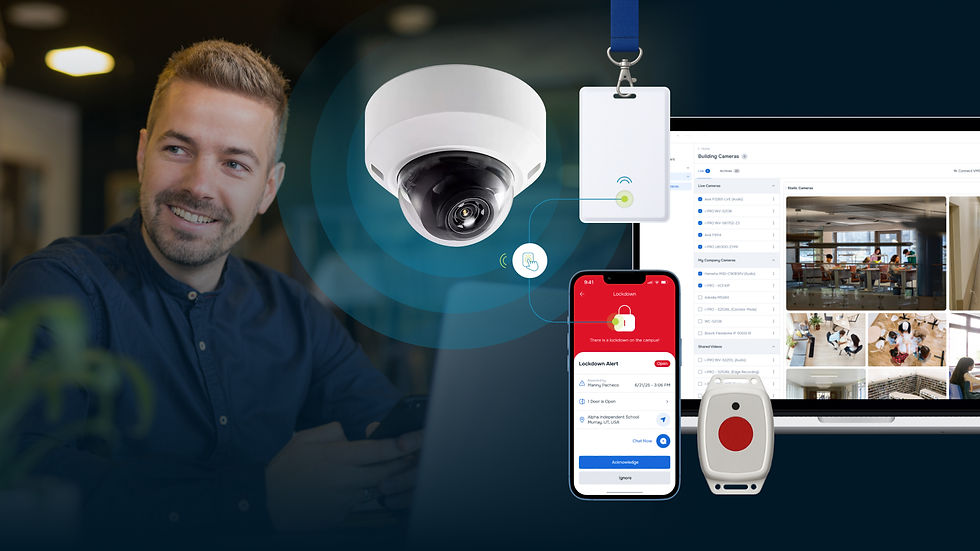
A connected incident response system, like NovoTrax turns device signals into structured workflows. The process may begin with a panic button, mobile app, RTLS badge, camera analytic, access control event, visitor management alert, or another connected device. But instead of stopping at a notification, the signal becomes part of a coordinated response path.
The NovoTrax Platform can help identify the location of the alert, apply context from other connected systems, notify the appropriate response groups, activate predefined workflows, and give leadership visibility into what is happening. It can also support follow-through by tracking actions, acknowledgments, escalations, and post-incident information.
This matters because every incident has moving parts. The people responding need more than a message. They need context. They need sequence. They need clarity. They need to know what has already happened and what still needs attention.
When devices are connected to workflows, the response becomes less dependent on improvised communication and more supported by structure.
This approach aligns with the broader emergency management principle of interoperability: different systems, agencies, and stakeholders need the ability to share information and coordinate effectively during an incident. FEMA’s NIMS framework was created to support that kind of shared approach across public, private, and nongovernmental organizations.
How NovoTrax Approaches Device Integration
NovoTrax is built around the idea that safety and operational technology should not operate in silos.
A panic button should not be just a panic button. A camera should not be just a camera. A location device should not be just a dot on a map. A mass notification tool should not be just a message sender.
Each signal should be able to contribute to a larger response process.
NovoTrax connects alerts, RTLS, video analytics, mass notification, access control, visitor management, Command Center, and other operational systems into intelligent workflows. This allows organizations to move from isolated alerts to coordinated action, where systems communicate, response steps can be automated, and teams can operate from shared context.
The purpose is not simply to collect more data or add another dashboard. The purpose is to help organizations turn real-time information into real-world action.
Why This Matters in Schools
In K–12 environments, the need for connected response is especially clear.
A school incident may involve teachers, administrators, school resource officers, district leadership, security personnel, dispatchers, parents, and first responders. Each group may need different information at different moments. Some people need to respond. Some need to stay informed. Some need instructions. Some need situational awareness before they arrive on site.
If the response depends on disconnected systems, that coordination becomes difficult. An alert may reach one group, while another group waits for a call. A camera feed may exist, but not be immediately tied to the location of the alert. A lockdown procedure may be documented, but still require manual activation across several systems.
Leadership may receive updates, but not have one clear view of response progress.
Connected systems help reduce that gap. When a staff member activates an alert, the value is not only that the signal is sent. The value is that the signal can connect to location, role-based notification, video context, lockdown workflows, mass communication, and responder visibility.
That is what helps a school move from awareness to action with less uncertainty.
Federal school safety resources also emphasize that preparedness requires planning, coordination, and continuous improvement. CISA’s K-12 School Security Guide Product Suite is designed to help schools assess vulnerabilities and implement layered security measures, while GAO has reported that school districts face challenges balancing emergency planning with other priorities and coordinating with external partners.
Why This Matters in Healthcare and Other Complex Environments
The same principle applies in healthcare, public safety, enterprise, and large facility environments.
In a hospital, a staff duress alert may require security, nursing leadership, administrators, facilities, and nearby teams to coordinate quickly. The response may need location context, access control support, camera visibility, and targeted communication that does not disrupt unrelated departments.
In a public safety or enterprise environment, the challenge may involve multiple buildings, response teams, systems, and decision-makers. Leaders need to understand what is happening, where it is happening, who is responding, and what actions are already underway.
In each case, the issue is not simply whether one device can communicate. The issue is whether the organization can coordinate response across people, systems, and locations.
That is why device integration should be viewed as an operational strategy, not just a technical feature.
Healthcare standards reinforce this need for structured response processes. The Joint Commission’s workplace violence prevention standards require healthcare organizations to have policies and procedures to prevent and respond to workplace violence, processes for reporting and analyzing incidents, and mechanisms for follow-up and governance reporting. These requirements point to a broader reality: technology is most valuable when it supports a defined, trackable, organization-wide response process.
More Devices Do Not Automatically Mean Better Response
One of the biggest misconceptions in safety technology is that adding more devices automatically improves preparedness.
It can, but only when those devices are connected to the right workflows.
Without integration, more devices can create more complexity. More dashboards to monitor. More alerts to interpret. More systems to check. More manual steps to complete. More opportunities for information to get delayed or missed.
The goal should not be to add technology for the sake of having more technology. The goal should be to reduce friction during response.
That means connecting systems in a way that helps teams act with greater clarity, consistency, and confidence.
The best incident response technology does not simply create more noise. It helps turn signals into meaningful action.
The Better Standard: Communication That Triggers Action
The next generation of incident response will not be defined only by whether organizations have safety devices. Most already do.
It will be defined by whether those devices can work together to support better decisions and more coordinated outcomes.
For leaders, the standard should be higher than asking, “Can this device send an alert?”
The better question is:
Can this system turn that alert into coordinated action?
That is where incident response technology becomes more valuable. It moves beyond communication alone and becomes part of a structured response environment where alerts, devices, workflows, teams, and systems work together.
Because in a critical moment, communication matters.
But communication is only powerful when it leads to action.
Conclusion
Incident response does not usually fail because an organization lacks devices. It often fails because those devices are disconnected from the people, systems, and workflows needed to respond effectively.
A device can send a signal. But a connected platform can help turn that signal into a coordinated response.
That is the shift leaders need to understand.
The future of incident response is not about adding more isolated tools. It is about building connected environments where every signal can activate the right workflow, inform the right people, and support the right action.
NovoTrax helps organizations close that gap by connecting devices, alerts, systems, and teams into intelligent workflows designed for real-world response.
Because when every second matters, the goal is not just to know that something happened.
The goal is to know what happens next.


Comments